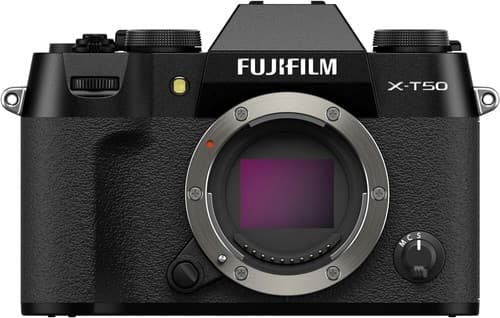
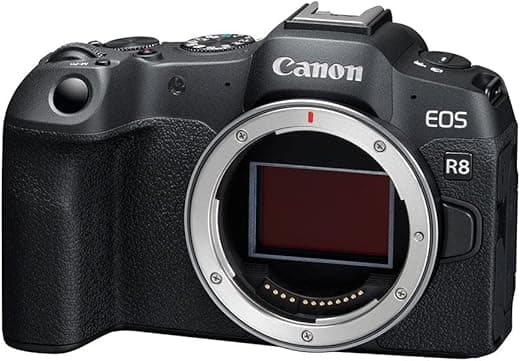
In the contest of Fujifilm X-T50 Mirrorless Camera (Body Only) vs Canon EOS R8 Mirrorless (Body Only) — AU Version, the Canon EOS R8 edges ahead as the stronger all-round buy for most Australian shoppers in 2026, thanks to its full-frame sensor advantage and superior autofocus system that expert reviewers consistently rank among the best in its price class. That said, the Fujifilm X-T50 is the clear winner for photography enthusiasts who prioritise colour art, creative in-camera processing, and a compact retro body they actually enjoy carrying. Neither camera is a wrong choice — but they serve genuinely different creative ambitions.
Quick Verdict
Buy the Fujifilm X-T50 Mirrorless Camera (Body Only) if you are a stills-first photographer who shoots portraits, street, or landscapes and wants Fujifilm's renowned 40MP X-Trans sensor with 20 Film Simulation modes dialled in from the top plate — delivering finished JPEGs straight out of camera that reviewers consistently describe as requiring minimal post-processing. This is the camera for you if aesthetic control and tactile shooting experience matter as much as raw technical output.
Buy the Canon EOS R8 Mirrorless (Body Only) — AU Version if you are a content creator, videographer, or hybrid shooter who needs full-frame image quality, Canon's class-leading Dual Pixel CMOS AF for reliable subject tracking in video, and long-term flexibility through the rapidly expanding Canon RF lens ecosystem. It is also the smarter choice if you shoot events, run-and-gun social content, or YouTube where autofocus reliability under variable lighting is non-negotiable.
Key Differences That Matter
Sensor Size: APS-C vs Full-Frame
The single most consequential difference between these two cameras is sensor size. The X-T50 uses a 40MP APS-C X-Trans sensor, while the EOS R8 uses a full-frame CMOS sensor. Full-frame sensors capture significantly more light per pixel, which translates to cleaner images at higher ISO values — a real-world advantage when you are shooting indoor events, dimly lit restaurants, or evening street scenes without flash. Reviewers of the R8 consistently report usable images at ISO 6400 and beyond, a threshold where APS-C sensors typically show more visible noise. The X-T50's 40MP resolution is genuinely impressive for its sensor class, but physics still favours the larger sensor in low-light scenarios.
Edge: Canon EOS R8 Mirrorless (Body Only) — AU Version — full-frame low-light performance that APS-C cannot match at any megapixel count.
Autofocus System and Subject Tracking
Canon's Dual Pixel CMOS AF, as found in the R8, is rated by multiple independent reviewers as one of the fastest and most reliable phase-detection autofocus systems available under A$3,000. It offers eye, face, and subject tracking that locks on quickly and holds through movement — critical for video creators filming interviews, action, or unpredictable subjects. Fujifilm's autofocus on the X-T50 is competent and has improved significantly through firmware updates, but expert reviews consistently place Canon's subject-tracking accuracy a clear step ahead, particularly in video mode where hunting and breathing artefacts are more visible.
Edge: Canon EOS R8 Mirrorless (Body Only) — AU Version — Dual Pixel CMOS AF delivers faster, more consistent subject tracking, especially in video.
Creative Colour and Film Simulation
This is where the X-T50 does something no Canon body at this price point attempts. The dedicated Film Simulation dial on the top plate lets you switch instantly between 20 colour profiles — including Velvia, Classic Chrome, Eterna Cinema, and Acros — each modelled on Fujifilm's legendary film stocks. Reviewers and working photographers consistently praise the X-Trans sensor's colour science as producing a distinct, painterly quality in JPEGs that Canon's colour profiles simply do not replicate. For photographers who want to shoot, share, and enjoy the process without hours in Lightroom, this is a genuine and meaningful feature difference, not just a marketing point.
Edge: Fujifilm X-T50 Mirrorless Camera (Body Only) — 20 Film Simulation modes plus a physical dial make in-camera colour art faster and more intuitive than any Canon equivalent.
Body Design, Buffer, and Handling
Both cameras are notably compact for their respective categories. The X-T50's retro-styled body with physical aperture and exposure dials appeals strongly to photographers who prefer direct manual control without diving into menus. However, reviewers note its buffer is smaller than the flagship X-T5, meaning burst-shooting sequences in RAW fill up faster — a real limitation for sports or wildlife photographers. The R8, while lightweight for a full-frame body, lacks in-body image stabilisation (IBIS), which reviewers flag as a meaningful omission for handheld video work. Neither body is weathersealed, which is worth noting for Australian outdoor shooters.
Edge: Fujifilm X-T50 Mirrorless Camera (Body Only) — superior tactile control layout for stills photographers who want direct physical access to key settings.
Value for Money in Australia
At A$2,485 for the X-T50 and A$2,524 for the R8, these cameras sit just A$40 apart — a gap so small it should carry zero weight in your decision. What matters is what each dollar delivers for your specific use. The R8's full-frame sensor and AF system represent exceptional value at this price point; reviewers frequently note it punches into territory previously reserved for cameras costing A$1,000 more. The X-T50 at A$2,485 is genuinely expensive for an APS-C body, and that is a weakness worth acknowledging — you are paying a premium for Fujifilm's unique colour science and Film Simulation ecosystem, not raw sensor size. Both cameras are available at major Australian retailers including JB Hi-Fi, Harvey Norman, and Amazon AU, and occasionally appear at competitive prices on eBay AU and Kogan.
Australian buyers should note that both products are covered by Australian Consumer Law statutory warranty rights, which are entirely separate from and in addition to the manufacturer's warranty. Under the ACL, a product must be of acceptable quality for a reasonable period — for a camera in this price range, consumer advocates generally consider that to extend well beyond a standard 12-month manufacturer warranty. If you purchase from an authorised Australian retailer such as JB Hi-Fi or Harvey Norman, your ACL rights are straightforward to exercise. Be cautious purchasing grey-market imports through unofficial channels, as ACL protections apply to the Australian seller, not an overseas supplier.
Who Should Buy the Fujifilm X-T50 Mirrorless Camera (Body Only)?
- Street and travel photographers who want a compact, retro-styled body that draws less attention than a DSLR and delivers 40MP stills with beautiful in-camera colour.
- Film photography converts who miss the distinct look of Velvia, Provia, or Classic Neg and want to replicate those aesthetics digitally without heavy post-processing.
- Portrait and lifestyle photographers who already shoot within the Fujifilm X-mount lens ecosystem and want a high-resolution body upgrade without switching systems.
- Minimalist workflow shooters who want to shoot, share finished JPEGs directly, and spend less time editing — Fujifilm's Film Simulation output is consistently praised for requiring minimal correction.
Who Should Buy the Canon EOS R8 Mirrorless (Body Only) — AU Version?
- YouTube and social media content creators who need reliable 4K video with fast, accurate subject tracking and clean full-frame footage in mixed lighting conditions.
- Event and wedding photographers stepping up from an entry-level crop-sensor body who need the low-light confidence and autofocus speed of a full-frame system for unpredictable shooting environments.
- Long-term system builders who want to invest in Canon's RF lens ecosystem, which offers one of the widest and fastest-growing selections of native mirrorless lenses available in Australia.
- Hybrid shooters who split their time between stills and video work and need a single body that performs credibly in both disciplines without compromise.
The Bottom Line
For most Australian buyers in 2026, the Canon EOS R8 is the stronger all-round investment — its full-frame sensor, class-leading Dual Pixel CMOS AF, and 4K video capability deliver more versatile performance across both photo and video at a price that expert reviewers consistently call exceptional for full-frame. The Fujifilm X-T50 wins decisively in one specific scenario: if you are a stills-focused photographer who genuinely values Fujifilm's Film Simulation colour science and wants a tactile, retro shooting experience that no Canon body in this category replicates.