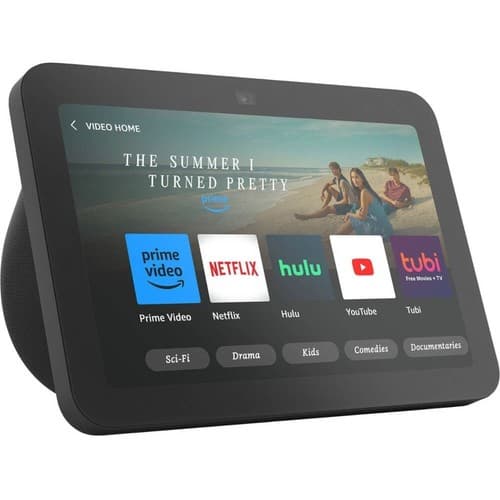
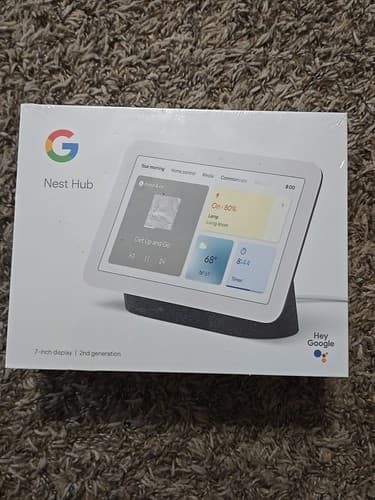
In the contest of Amazon Echo Show 8 3rd Generation Smart Display vs Google Nest Hub 2nd Generation Smart Display, the Echo Show 8 is the stronger all-round smart display for most Australian households, delivering a larger screen, a capable 13MP camera, and richer audio at a lower price. The Nest Hub 2nd Generation, however, earns its place as the outright best smart display for the bedroom, where its camera-free design and Soli radar sleep sensing address a genuinely different set of needs. Neither device is wrong — they are aimed at different rooms and different priorities.
Quick Verdict
Buy the Amazon Echo Show 8 3rd Generation Smart Display if you want a versatile kitchen or living room hub that handles video calls via its 13MP auto-framing camera, streams music with spatial audio, and acts as a central Alexa smart home dashboard you can interact with throughout the day.
Buy the Google Nest Hub 2nd Generation Smart Display if you want a bedside display that passively tracks your sleep quality using Soli radar without any camera in the room, adjusts its screen brightness to match ambient lighting automatically, and connects seamlessly to your existing Google Photos library and YouTube subscriptions.
Key Differences That Matter
Screen Size and Daily Usability
The Echo Show 8 carries an 8-inch HD touchscreen against the Nest Hub's 7-inch display. That one-inch difference sounds modest, but expert reviewers consistently note it is meaningful when you are glancing at a recipe from across a kitchen bench, reading a calendar, or managing a smart home dashboard from a few metres away. The Echo Show 8's larger canvas makes text and widget layouts noticeably more readable at a distance. The Nest Hub's smaller screen is intentional — it is designed to sit on a bedside table where you are always close to it, and at that range the size difference stops mattering.
Edge: Amazon Echo Show 8 3rd Generation Smart Display — the 8-inch screen is meaningfully more usable in shared living spaces where you glance rather than lean in.
Camera and Video Calling
The Echo Show 8's 13MP auto-framing camera is one of the most practically useful features on any smart display in this price range, according to multiple expert reviews. It automatically pans and zooms to keep you centred during video calls — useful when you are moving around a kitchen or home office. Supported apps include Alexa calling, Zoom, and Amazon's own Drop-In feature. The Nest Hub 2nd Generation has no camera at all. Google made that choice deliberately for bedroom privacy, and verified user feedback confirms Australian buyers in that category genuinely value it. But it means video calling from the Nest Hub is simply not possible, which is a hard limitation if that matters to you.
Edge: Amazon Echo Show 8 3rd Generation Smart Display — a 13MP auto-framing camera versus no camera is not a close comparison for anyone who wants video calls.
Sleep Sensing and Bedroom Intelligence
The Nest Hub 2nd Generation uses Google's Soli radar chip to detect your breathing and movement during sleep, generating a sleep score each morning without any wearable or camera. Expert reviewers describe this as a genuinely novel feature at this price point. The catch, confirmed by multiple verified user reports, is that the full feature set requires a Fitbit account — an extra step that some Australian buyers find friction-heavy. The Echo Show 8 offers nothing comparable. If sleep tracking is on your wishlist, the Nest Hub is the only device in this comparison that can deliver it.
Edge: Google Nest Hub 2nd Generation Smart Display — Soli radar sleep sensing is a hardware feature the Echo Show 8 cannot match, and it works without wearing anything to bed.
Ecosystem and On-Screen Experience
Both devices carry their parent company's ecosystem strengths and weaknesses. The Echo Show 8 runs Alexa and integrates deeply with Amazon services, smart home devices, and third-party Alexa skills. Reviewers consistently flag one genuine downside: Amazon displays promotional content and suggestions on the home screen, which some users find intrusive. The Nest Hub runs Google Assistant with native YouTube, Google Photos, and Chromecast support — a clear win for households already invested in Google services. The Nest Hub's Ambient EQ feature, which adjusts screen colour temperature and brightness to match the room's lighting conditions, is consistently praised by reviewers as a small but meaningful quality-of-life detail, particularly for bedside use.
Edge: Google Nest Hub 2nd Generation Smart Display — for Google-ecosystem households, native YouTube and Google Photos access plus Ambient EQ creates a more cohesive experience than the Echo Show 8's ad-dotted home screen.
Value for Money in Australia
The Echo Show 8 3rd Generation is available for around A$163 through Amazon AU, while the Nest Hub 2nd Generation sits at approximately A$210 through JB Hi-Fi, Harvey Norman, and Amazon AU. That is a A$47 gap — real money. For most buyers, the Echo Show 8 delivers more features per dollar: a larger screen, a 13MP camera, spatial audio, and photo frame mode, all for less. The Nest Hub's premium is justified only if sleep sensing or bedroom privacy is a genuine priority for you. If neither of those features applies to your household, the Echo Show 8 is the smarter financial decision.
Australian shoppers should note that both products are covered by Australian Consumer Law statutory warranty rights, which guarantee that goods must be of acceptable quality and fit for their stated purpose — rights that exist independently of any manufacturer warranty period. This means if either device develops a fault within a reasonable time, you have remedies through the retailer under ACL regardless of what the manufacturer's warranty document says. It is worth buying from a named Australian retailer — JB Hi-Fi, Harvey Norman, or Officeworks — rather than a grey-market seller on eBay AU or Kogan, where ACL enforcement can be more complicated.
Who Should Buy the Amazon Echo Show 8 3rd Generation Smart Display?
- Kitchen and bench users who want hands-free recipe guidance, timers, and video calls with a camera that tracks their movement around the room.
- Amazon smart home households already running Alexa-compatible lights, locks, or appliances who want a central touchscreen dashboard to manage everything visually.
- Families or housemates who make regular video calls via Zoom or Alexa calling and need a shared device that does not require holding a phone or laptop.
- Music and streaming listeners who want spatial audio performance from a bedside or desk speaker that also doubles as a visual display for album art, lyrics, and streaming apps.
Who Should Buy the Google Nest Hub 2nd Generation Smart Display?
- Privacy-conscious bedroom users who want a smart display on the bedside table but are uncomfortable with a camera in the room while they sleep.
- Sleep trackers who want passive overnight sleep sensing via Soli radar without wearing a smartwatch or fitness band to bed every night.
- Google Photos households who want their photo library to appear naturally on a display that auto-adjusts colour temperature to match the room's ambient light throughout the day.
- YouTube and Chromecast users who want native access to their YouTube subscriptions and the ability to cast content to a TV directly from the display without workarounds.
The Bottom Line
The Amazon Echo Show 8 3rd Generation Smart Display wins this comparison for most Australian buyers — it offers more screen, a genuinely capable auto-framing camera, and stronger all-round versatility at a lower price point. The single scenario where the Google Nest Hub 2nd Generation Smart Display is the clear choice is the bedroom: its camera-free privacy, Soli radar sleep sensing, and Ambient EQ display make it purpose-built for that room in a way the Echo Show 8 simply is not. Choose the room first, and the right device becomes obvious.