ASUS ROG Ally vs Steam Deck OLED: Which Handheld PC is the Ultimate King of Portable Gaming?
 CompareMates Editorial Team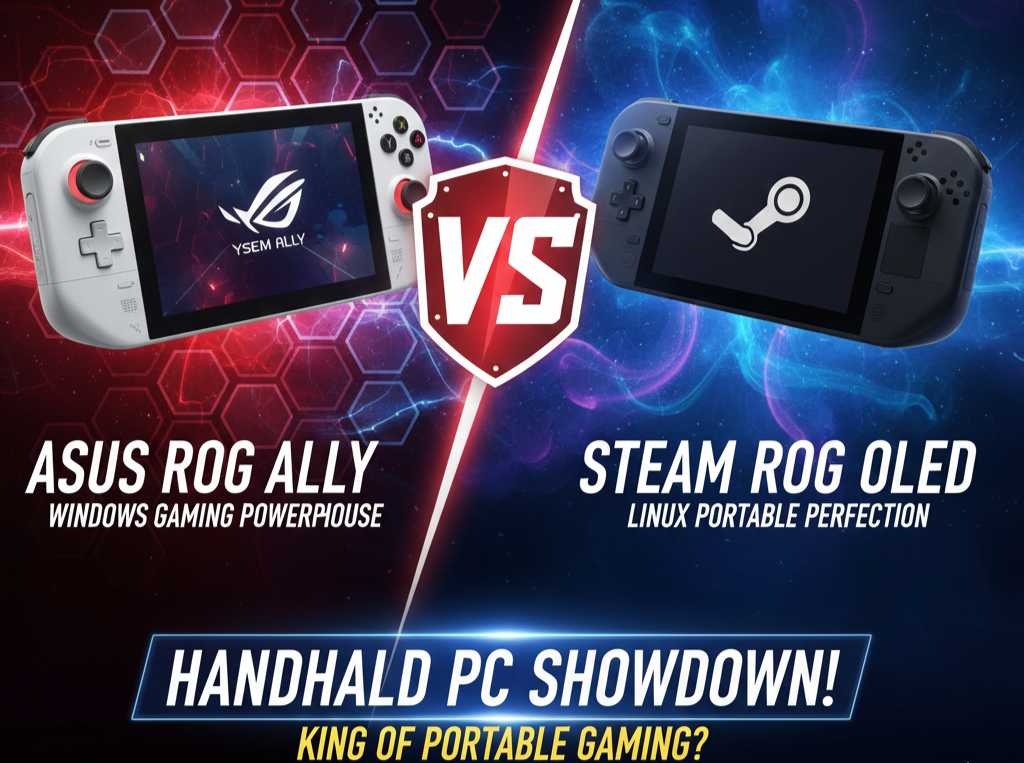
The battle for handheld gaming supremacy is heating up in Australia, with two heavyweights vying for your attention: the Asus ROG Ally vs Steam Deck OLED. If you’re trying to decide between these two portable gaming PCs, you’re not alone—Australian gamers are weighing up whether the raw power and flexibility of the ROG Ally vs Steam Deck OLED justifies the price difference, or if Valve’s refined handheld gaming PC offers better value. Both devices promise to deliver your favourite PC games on the go, but they take very different approaches. Let’s break down which one deserves the crown.
Table of Contents
Asus ROG Ally vs Steam Deck OLED — Key Differences
Understanding the core specifications helps clarify what each portable gaming PC brings to the table.
| Feature / Metric | ROG Ally X | Steam Deck OLED |
|---|---|---|
| CPU / GPU / Power | More powerful — AMD Z1 Extreme (Zen4, higher cores/threads, RDNA3 GPU) | Less powerful — AMD Zen2 + RDNA2 GPU |
| RAM / Headroom | 16–24 GB “handheld-class” RAM (depending on config) — more headroom for heavy PC games/apps | 16 GB LPDDR5 — sufficient for many Steam games, but less room for heavier multitasking or non-Steam PC games |
| Display / Refresh Rate / Resolution | 7.0″ IPS, 1080p, up to 120 Hz (plus VRR) — sharper image, smoother motion | 7.4″ OLED, 1280×800, 90 Hz — excellent colours/contrast, but lower resolution and refresh rate |
| Battery & Portability | Large 80 Wh battery (in X model) — strong battery life for a powerful handheld | Smaller battery (~50 Wh) — but more efficient hardware, often offering competitive endurance given lower resolution load |
| OS / Flexibility | Windows 11 — can run virtually any PC game or launcher (Steam, Epic, GOG, emulators, etc) | SteamOS (Linux-based) — best for Steam library, streamlined console-like experience; supports many PC games via Proton, but fewer out-of-the-box than Windows |
| Price in Australia (relative) | High — generally more expensive (est. RRP significantly above top-tier Steam Deck) | More budget-friendly — official Australian pricing significantly lower than ROG Ally X. |
Performance & Hardware
The ROG Ally X packs significantly more punch with its AMD Z1 Extreme chip featuring Zen4 architecture and RDNA3 graphics, while the Steam Deck OLED relies on older Zen2 and RDNA2 technology. The Ally X offers between 16-24GB of RAM depending on configuration, providing more headroom for demanding PC games and multitasking, compared to the Steam Deck’s 16GB LPDDR5 memory.
Display Quality
Here’s where things get interesting. The ROG Ally X features a 7.0-inch IPS display running at 1080p resolution with up to 120Hz refresh rate and VRR (Variable Refresh Rate) support, delivering sharper images and smoother motion. Meanwhile, the Steam Deck OLED sports a slightly larger 7.4-inch screen with vibrant OLED technology, though it runs at a lower 1280×800 resolution and 90Hz refresh rate.

Asus ROG Ally X 7" 1TB 24GB DDR5 Wi-Fi 6E Handheld Gaming Console
- Processor: AMD Ryzen Z1 Extreme Processor (Zen4 architecture with 4nm process, 8 core /16 threads, 24MB total cache, up to 5.10 Ghz boost) CPU power: TDP: 9 30W IGPU: AMD Radeon Graphics (AMD RDNA 3, 12 CUs, up to 2.7 GHz, up to 8.6 Teraflop). S
- Screen size: 7 inches Screen definition: FHD (1920 x 1080) 16:9 Refresh rate: 120Hz Response time (G2G): 7ms Glass type: Gorilla Glass Victus Touch Screen: Touch Screen (10 point multi touch) Viewing angle: 85/85/85/85 Panel technology: IPS level Lumino. site: 5000 nits Contrast: 1200:1 Processing type: Glossy screen Adaptative Sync Technology: FreeSync Premium
- Embedded memory: 12GB x 2 LPDDR5 embedded Total system memory: LPDDR5X 24GB Multi channel memory technology: Support dual channel memory System storage: 1TB PCIe 4.0 NVMe M.2 SSD (2280) Number of M.2 slots supported (SATA/NVME): 1 M.2 SSD support list: M.2 2280 1TB SSD / M.2 2280 512GB SSD
- Wireless connectivity: Wi Fi 6E(802.11ax) (Triple band) 22 + Bluetooth 5.2 (Bluetooth version may vary depending on operating system.) Input/output ports: 1 x Thunderbolt 4 support DisplayPort/Power Delivery 1x USB 3.2 Gen 2 Type C support DisplayPort/Power Delivery 1x UHS II microSD card reader (supports SD, SDXC and SDHC) Video Output N/A : Audio 1x 3.5mm Combo Audio Jack Microphone: Built in array microphone Aura Sync technology: yes
- Audio technology: AI noise canceling technology / Dolby Atmos / Hi Res certification (for headphone) / Smart Amp Technology Operating system: Windows 11 Home Dimensions (L x W x H): 28.0 x 11.1 x 2.47 ~ 1.5 inches Weight: 670 g
Battery & Endurance
The ROG Ally X comes equipped with a substantial 80Wh battery, significantly larger than the Steam Deck’s approximately 50Wh cell. However, the Deck’s more efficient hardware often delivers competitive battery life thanks to its lower resolution demands.
Operating System
This might be the biggest differentiator. The ROG Ally X runs full Windows 11, giving you access to virtually any PC game launcher including Steam, Epic, GOG, and emulators. The Steam Deck OLED uses SteamOS, a Linux-based system that provides a streamlined, console-like experience optimised for Steam games, though many PC games work through Proton compatibility.

VALVE Steam Deck OLED 1TB SSD + 16GB RAM (International Version) – 7.4" inch, 90Hz, 1280 x 800px, SteamOS 3.0, Handheld Gaming Console
- Expansive 7.4″ diagonal display
- 1280 x 800 HDR OLED screen
- Premium anti-glare etched glass
- 1TB NVMe SSD high-speed internal storage
- Fast processing with 6nm APU
Australian Pricing
Budget matters, especially in Australia. The ROG Ally X commands a premium price, significantly exceeding the cost of top-tier Steam Deck models. The Steam Deck OLED offers more budget-friendly official Australian pricing, making it considerably more accessible.
Also check out Nintendo Switch 2 vs Lenovo Legion Go S Comparison
Where Each Handheld Shines
Why Choose ROG Ally X
Raw Performance & Versatility
Thanks to its stronger CPU/GPU and additional RAM, the ROG Ally X excels with heavier, newer PC titles including demanding AAA games, modded games, and non-Steam releases. If you’re someone who wants to play Cyberpunk 2077, Starfield, or heavily modded Skyrim on the go, the extra horsepower makes a noticeable difference.
Windows Flexibility
Running Windows 11 means you’re not restricted to Steam—you get full access to Epic Games Store, GOG, EA, Xbox PC Game Pass, emulators, and PC-style multitasking. This makes the ROG Ally X function more like a genuine portable PC than just a gaming console.
Display Advantages
The 1080p IPS panel with 120Hz refresh rate and VRR delivers sharper visuals and smoother frame rates, particularly beneficial when pushing graphics settings. For competitive games or titles where every frame counts, this matters.
Battery Capacity
The larger 80Wh battery helps offset increased power consumption during intensive gaming sessions, making it a genuine portable PC rather than just a handheld console.
Best for: PC enthusiasts, modding communities, players tackling demanding new releases, or anyone wanting maximum flexibility beyond Steam—particularly those willing to invest more for performance and versatility.
Why Choose Steam Deck OLED
Superior Display Experience
The OLED screen delivers vibrant colours, deep blacks, and stunning visual quality—especially impressive for indie games, first-party titles, and less graphically intensive games. The difference in colour and contrast is immediately noticeable.
Console-Like Simplicity
SteamOS provides a streamlined, controller-friendly interface optimised for handheld gaming—a smoother, more plug-and-play experience than managing Windows settings and configurations. You turn it on, pick a game, and play. No fussing with drivers or Windows updates.
Value for Money
Compared to the ROG Ally X, the Steam Deck OLED is significantly more affordable in Australia—ideal for budget-conscious gamers or those prioritising value over absolute performance. The price difference can be substantial.
Efficiency & Battery Life
Since many Steam games run well at 800p resolution on the Deck, the hardware operates more efficiently—resulting in less strain, smoother performance, and reasonable battery endurance relative to the workload.
Best for: Gamers wanting a hassle-free, plug-and-play handheld gaming PC for Steam libraries, indie titles, and less demanding games—especially at a more accessible price point.
Trade-offs & What to Consider
ROG Ally X Drawbacks
The Ally X costs more upfront, and because it runs Windows, it can feel less console-friendly—some games and controls may require tweaking and optimisation. You’re trading convenience for power and flexibility.
Steam Deck OLED Limitations
The lower resolution and refresh rate, combined with less powerful hardware, means modern AAA games often require downscaling or reduced settings, and there’s less flexibility for non-Steam titles or PC-specific modifications.
Battery Behaviour
Despite the Ally X’s larger battery, heavy usage under Windows can drain it faster, while the Steam Deck’s efficiency advantage may still struggle with more intensive games or higher graphics settings. Real-world battery life depends heavily on what you’re playing and at what settings.
Verdict — Which Handheld PC Is the King of Portable Gaming?
There’s no single king—it depends on your priorities.
Choose the ROG Ally X if you want maximum PC-like power, flexibility, and future-proofing. It’s ideal for running diverse PC games across multiple launchers, tackling modern AAA titles, and using mods or emulators. The ROG Ally X is genuinely the king of portable gaming PCs for those who want a mini-PC in their hands.
Choose the Steam Deck OLED if you prioritise value, ease of use, beautiful OLED visuals, and a console-like experience. It remains the smarter, more budget-friendly pick for Steam games, indie titles, and less demanding releases.
For most Australian gamers, the decision boils down to “power and versatility” versus “simplicity and value.”
What This Means for Australian Buyers
Good news for Aussies: the Steam Deck OLED is officially available in Australia with clear pricing (AU$899 for 512GB OLED, AU$1,049 for 1TB), eliminating grey-market hassles.
The ROG Ally X, while pricier, appeals to serious PC gamers wanting a portable device that behaves like a mini-PC rather than just a console. If you’re budget-conscious or new to handheld gaming, the Steam Deck OLED offers an accessible entry point that’s still highly capable.
Insert Content Egg: Australian retailer listings for handheld gaming PCs
FAQs
Is the ROG Ally X more powerful than the Steam Deck OLED?
Yes, the ROG Ally X features significantly more powerful hardware with its AMD Z1 Extreme processor, more RAM, and newer GPU architecture compared to the Steam Deck OLED. This translates to better performance in demanding AAA games and greater multitasking capability.
Which has better battery life—ROG Ally X or Steam Deck OLED?
While the ROG Ally X has a larger 80Wh battery, the Steam Deck OLED’s more efficient hardware and lower resolution often result in competitive battery life in real-world use. Battery performance heavily depends on the games you play and graphics settings used.
Can the Steam Deck OLED run non-Steam games?
Yes, though with limitations. The Steam Deck OLED can run many non-Steam games through Proton compatibility and desktop mode, but the Windows-based ROG Ally X offers broader compatibility with other launchers like Epic Games Store, GOG, and Xbox PC Game Pass without workarounds.
Is the Steam Deck OLED’s display better than the ROG Ally X?
It depends on priorities. The Steam Deck OLED offers superior colour reproduction, contrast, and blacks thanks to OLED technology. However, the ROG Ally X provides sharper images with its 1080p resolution and smoother motion with its 120Hz refresh rate. OLED quality versus resolution and refresh rate.
Which handheld gaming PC offers better value in Australia?
The Steam Deck OLED provides better value for most Australian buyers, with official local pricing significantly lower than the ROG Ally X. Unless you specifically need the extra power and Windows flexibility, the Steam Deck delivers excellent performance per dollar.
Can I upgrade the storage on both devices?
Both devices support storage expansion. The Steam Deck OLED uses a microSD card slot for easy expansion, while the ROG Ally X also supports microSD cards and potentially internal SSD upgrades depending on your technical comfort level.
Conclusion
Both the ROG Ally X and Steam Deck OLED are excellent handheld gaming PCs, but they serve different audiences. The ROG Ally X dominates when raw power, Windows flexibility, and future-proofing matter most—it’s the ultimate portable gaming PC for enthusiasts willing to pay premium prices. The Steam Deck OLED excels in delivering beautiful visuals, hassle-free gaming, and outstanding value—particularly for Australian buyers watching their budget.
Your perfect handheld gaming PC depends on whether you value maximum versatility and performance, or prefer simplicity, value, and that stunning OLED screen. Either way, portable PC gaming in Australia has never looked better.
Prices and specifications are subject to change. CompareMates may earn commission from affiliate links at no extra cost to you. This content is for informational purposes only—always verify current details with official retailers before purchasing. Last updated: November 2025.